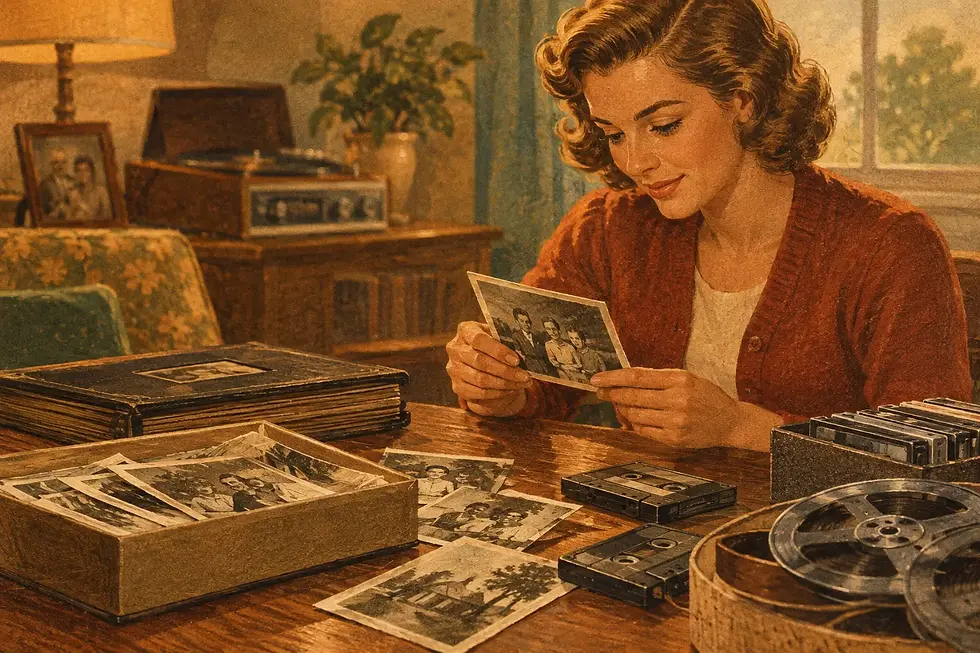
Family Heritage for Future Generations

A daughter finds a box of old photos after her mother dies. The names on the back are familiar, but the stories are gone. She knows who these people were. She does not know what made them laugh, what they feared, how they met, or what they hoped their family would carry forward. That quiet loss is exactly why family heritage for future generations matters.
Most families do not lose their history all at once. It happens gradually. A grandfather says, "I should really write this down someday." A mother means to label the photo albums. A veteran has stories he only tells at Thanksgiving, and then one year he is no longer at the table. What disappears first is not usually the dates. It is the voice, the personality, the small details that make a life feel real.
If you are thinking about preserving your family story, you do not need to create a museum-quality archive or produce a 400-page memoir. You only need a thoughtful way to capture what matters while the people who lived it can still tell it. That is the difference between a project that stays in your good intentions folder and one that becomes something your grandchildren can actually hold, hear, and return to.
What family heritage for future generations really means
When people hear the word heritage, they often think of genealogy charts, immigration records, military papers, or antique furniture. Those things matter. But family heritage is also made of voice and memory. It is the recipe with no measurements because "you just know." It is the story of why your parents moved across the country, how your grandmother got through a hard season, or what your family believed was worth sacrificing for.
For future generations, heritage is not only information. It is orientation. It helps children and grandchildren understand where they come from, what shaped the family, and what values have been tested over time. That can offer real comfort, especially when life feels uncertain or disconnected.
There is also a trade-off worth naming. A family can preserve facts without preserving feeling. A family tree may tell a child that their great-grandfather was a machinist in Ohio. A spoken story might tell them he worked nights, came home smelling like metal and oil, and still made pancakes every Sunday. One is useful. The other is unforgettable.
Why stories are often the first thing to disappear
Many families assume the stories will somehow stay alive on their own. They rarely do. Modern family life is busy, spread out, and distracted. Relatives live in different states. Gatherings are shorter. Fewer people sit long enough to ask follow-up questions. Even when families care deeply, they often do not know how to begin.
There is another obstacle too: the person with the stories may not want to "write a book." That phrase can sound heavy, formal, and exhausting. Plenty of older adults have no interest in staring at a blank page, learning a new app, or recording themselves into a platform that feels cold and impersonal. They do want to be heard. They just want someone patient enough to listen.
That is why spoken storytelling works so well. Conversation is natural. One memory leads to another. A question about a first job turns into a story about a brother, a move, a marriage, a war, a church, a neighborhood, or a turning point nobody in the family knew about. The best family history often comes out sideways, not in neat chronological order.
The pieces of a lasting family legacy
If your goal is family heritage for future generations, think beyond a stack of notes or a folder of audio files. The most meaningful legacy projects usually preserve several layers at once.
First, there is the narrative itself - the story shaped into readable form so children and grandchildren are not left trying to make sense of rough transcripts. Second, there is the voice. Hearing someone laugh, pause, or grow quiet during an important memory brings a dimension that text alone cannot carry. Third, there are the visual anchors, such as family photos, captions, and dates that help younger relatives connect names to faces.
Then there is permanence. This part gets overlooked. Families often mean well and save recordings on a phone, laptop, or flash drive. Years later, passwords are forgotten, files are scattered, and no one is quite sure what version is the final one. A good preservation process makes the material accessible now and durable later.
That does not mean every family needs the same final format. It depends on who the project is for. Some families want a color digital book that can be shared widely and easily. Others care most about a printed hardcover that can sit on a coffee table and be handed down. Often, the strongest approach is both: something simple to share and something tangible to keep.
How to preserve family heritage without making it a burden
The biggest mistake families make is assuming this has to be complicated. It does not. In fact, the simpler the process, the more likely it is to happen.
Start with one person, not the whole family archive. Choose the parent, grandparent, aunt, or uncle whose stories you most want to preserve. Then begin with conversation, not paperwork. Ask about childhood, work, courtship, parenting, faith, hardship, funny family habits, and the lessons they learned the hard way. You are not conducting an interrogation. You are giving someone room to remember.
It helps to have a real human guide. That can be a family member with time and patience, or a service built around personal interviews and careful production. This is where many people feel relief. They realize they do not have to become writers, editors, audio engineers, and designers just to preserve one life well.
A thoughtful process usually looks like this: the stories are gathered in conversation, transcribed accurately, gently edited so the speaker still sounds like themselves, organized into a readable structure, and paired with photographs if the family wants them included. After that, the project can be turned into a polished digital book, a printed keepsake, or both.
The human part matters here. When someone feels listened to, they often share more honestly. They do not perform. They remember. That is one reason a guided interview often produces a richer result than a list of emailed prompts or a self-recorded app session.
What future generations actually value
Families sometimes worry that younger relatives will not care. Usually, that fear is misplaced. Children and grandchildren may not ask for these stories every day, but when they are ready for them, they treasure them.
What they value most is not perfection. It is recognition. They want to hear the real voice of the people who came before them. They want context for family traditions, old tensions, turning points, and values that shaped the household they grew up in. They want to know what their elders were like before they were Mom, Dad, Grandpa, or Grandma.
And yes, they often care more as they get older. A story that seems mildly interesting at age twenty-five can feel priceless at forty-five. By then, many people have children of their own, have lost loved ones, or have reached the age where they finally understand how much effort and courage a life can require.
A more personal way to create family heritage for future generations
This kind of work goes best when it feels dignified and manageable. That is why a done-with-you or done-for-you approach can be so meaningful, especially for older adults who do not want to wrestle with software or turn their memories into a technical project. Heritage Circle was built around that idea: real interviews, careful shaping, preserved audio, and a finished legacy book people can share without fuss.
That human support is not a luxury. For many families, it is the reason the project happens at all. Good intentions are common. Follow-through is rarer. A gentle process, led by someone who knows how to listen and how to make the material last, removes a great deal of friction.
There is no perfect time to begin. There is only the time when someone is still here to tell the story in their own words. If your family has been meaning to do this "someday," someday will feel a lot better once it has a date on the calendar.