How to Record Family History for Children

A child may not remember the name of a great-grandparent’s first school, the street where Grandma learned to ride a bike, or what Grandpa did during his first job. But someday, often much later than we expect, those details become precious. To record family history for children is to give them more than dates and names. It gives them a sense of where they come from, who loved them before they arrived, and what their family has carried through the years.
The good news is that this does not require anyone to become a writer, learn complicated software, or turn family time into a formal research project. The best family histories usually begin with a good conversation and someone willing to listen carefully.
Start with the stories children will want to hear
Many people hear “family history” and picture a chart full of branches, birth records, and distant cousins. Those things have their place, especially for families interested in genealogy. But children often connect first with stories that feel alive.
They want to know what their parent was like at their age. They want to hear about the dog that escaped at a family picnic, the apartment where two people started their marriage, the meal everyone requested on birthdays, or the hard season the family survived together. A story about moving across the country with one suitcase may teach more about courage than a list of addresses ever could.
Begin with a simple question: what would you want a child in your family to understand about the people who came before them? The answer may include values such as generosity, faith, humor, persistence, service, or love of learning. Let those themes guide the stories you preserve.
Make room for a real conversation
The most meaningful memories rarely arrive on command. A parent or grandparent may need a little time to settle in, remember, and follow a memory where it leads. That is why a relaxed interview often works better than handing someone a long list of written prompts.
Choose a quiet time when the storyteller is comfortable. A phone call can work beautifully, particularly when family members live in different states. So can a conversation at the kitchen table, where an old photograph, recipe card, or favorite song may stir a memory that had not surfaced in years.
You do not need to ask every question at once. A series of shorter conversations is often easier and more enjoyable than one long session. It also gives everyone time to remember the stories that begin with, “Oh, I should have told you about...”
A few gentle questions can open the door:
What did your home feel like when you were growing up?
Who made you feel safe, understood, or encouraged?
What was a turning point in your life?
What do you hope your children and grandchildren remember about you?
Follow the story, rather than rushing to the next question. If someone pauses to describe the smell of their mother’s cooking or the sound of a porch screen closing in summer, stay there for a moment. Those small details are often what make a family story feel real to a child decades from now.
Ask about ordinary life, not only major milestones
Weddings, military service, career achievements, and moves are all worth preserving. Still, ordinary life is where much of a family’s character lives. Ask what people did on Saturdays, how holidays were celebrated, who told the best jokes, and what happened when someone got in trouble.
Children learn from the imperfect parts, too. A carefully told story about a mistake, a disappointment, or a difficult choice can be deeply comforting. It reminds them that the people they admire were human beings who had to figure things out as they went.
Preserve the voice as well as the words
A written story is a gift. Hearing a loved one tell it is another kind of gift altogether.
A voice carries warmth, timing, laughter, regional expressions, and the little pauses that make a person recognizable. For a child who is still young, or for a future grandchild who never gets the chance to meet that person, a recording can become a remarkably close connection.
If you record conversations yourself, use the simplest reliable method available to you. Test it before you begin, keep the device nearby, and save copies in more than one place. Do not let perfect sound quality become the reason the story is never captured. Clear, sincere words matter more than studio polish.
There is a trade-off, of course. Raw audio is wonderfully personal but can be difficult for children to revisit if it is buried in a phone folder with an unhelpful file name. A written transcript makes stories easier to read, search, share, and return to. The strongest approach is often to keep both: the spoken voice and a thoughtfully shaped written version.
Gather photos with context
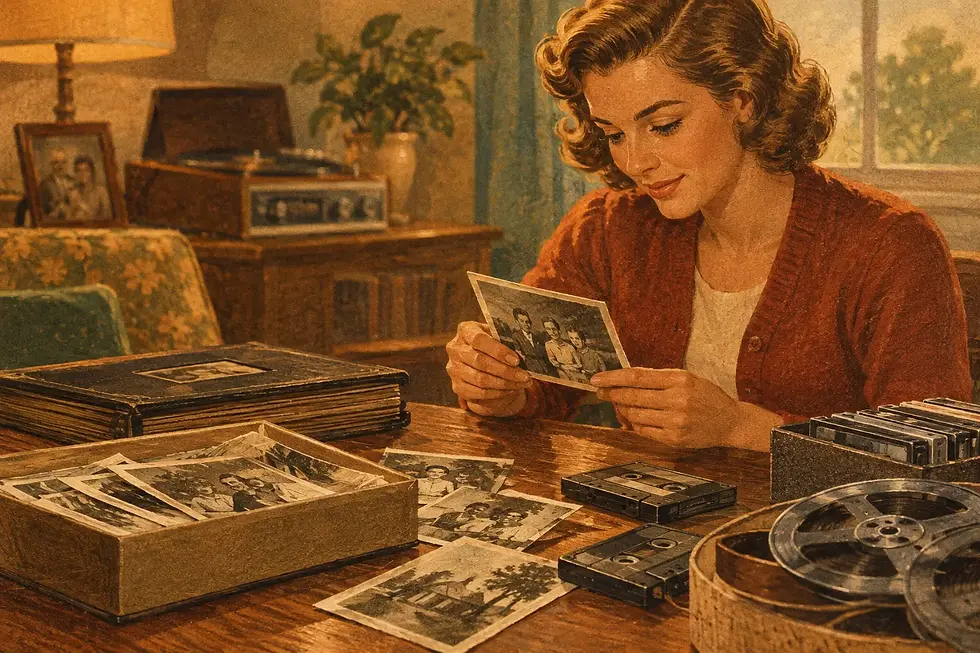
A box of old photos can hold a family history, but only if someone explains what the pictures show. Children may recognize a familiar face, yet have no idea who stood beside them, where the photograph was taken, or why that day mattered.
As you look through photos together, ask for names, approximate dates, places, and the story behind the image. Write down what you learn while the conversation is fresh. Even a brief note such as “Aunt Louise and her sisters outside the family grocery, Ohio, about 1948” can save a photo from becoming a mystery.
Do not feel obligated to include every image. A smaller group of meaningful photographs, paired with clear captions and stories, is more inviting than a crowded collection with no explanation. Include a few imperfect pictures, too. A faded snapshot from a fishing trip may say more about a family than a formal portrait ever could.
Shape the history around the child’s experience
When you record family history for children, organization matters because it helps them enter the story. A strict chronological account can be useful, but it is not the only option. Some families prefer chapters built around themes: childhood homes, family traditions, work and service, love stories, lessons learned, or favorite memories.
Consider including direct messages to children and grandchildren. A grandparent might share what they were proudest of, what they wish they had known sooner, or what they hope the next generation never forgets. These words do not need to sound grand. Plainspoken affection is usually the part people hold onto.
It also helps to explain relationships clearly. A young reader should not have to decode who belongs where. Simple labels, a modest family tree, and short introductions can make the history welcoming rather than overwhelming.
Give the stories a home that will last
Preserving a story is not the same as simply recording it. Files can be misplaced, passwords forgotten, and old devices retired to a drawer. A durable family history needs clear names, backed-up copies, and a format that people can actually use.
For many families, a book becomes the natural home. It can sit on a coffee table, travel to a reunion, or be handed to a child at graduation. A digital copy makes sharing easier with relatives across the country. Audio connected to the written story gives future readers the chance to hear the person behind the page.
This is also where personal help can make a meaningful difference. Heritage Circle, for example, helps families turn spoken interviews into professionally formatted legacy books, with written stories, photographs, audio access, and long-term digital preservation. The point is not to make a family perform for technology. It is to make sure a loved one is heard.
Do not wait for the perfect time
Families often postpone this work because life is busy, a parent says their stories are not interesting, or everyone assumes there will be more time. Sometimes there is. Sometimes there is not.
Start with one conversation. Ask about a first home, a cherished tradition, or the person who shaped their life. Save the recording. Write down the names in the photographs. Let the project grow at a pace that feels kind rather than burdensome.
One day, a child may open those pages or hear that familiar voice and realize that family history is not something distant. It is a living inheritance, offered with love.