How to Turn Family Stories Into a Book That Lasts

A grandson asks his grandfather what it was like to come home from the war. A daughter finally hears why her mother left her small hometown at 18. A grandmother describes the kitchen table where every holiday seemed to happen. These are not small stories. They are the details a family reaches for years later, usually after they are hardest to recover.
To turn family stories into a book is not simply to gather dates, names, and photographs. It is to preserve the voice behind the facts: the pause before a difficult memory, the laugh at an old family mishap, the lesson a parent hopes a grandchild will carry forward. A good legacy book makes room for all of that without asking someone to become a writer, a technology expert, or the manager of another complicated project.
Start with conversation, not a blank page
Many people postpone a memoir because they picture a daunting writing assignment. They imagine staring at a blank document, trying to organize eight decades of life in the right order. That is enough to make even a great storyteller say, "Maybe later."
The better starting point is a real conversation with someone who knows how to listen. Spoken stories tend to arrive naturally. One memory leads to another: a first job recalls a favorite coworker; a childhood home brings back a sibling, a family recipe, or the sound of a screen door in summer.
An interview also takes pressure off the storyteller. There is no need to spell every name correctly on the spot or remember every year with perfect precision. Those details can be checked later. What matters first is the memory itself and the meaning attached to it.
For some people, one long conversation works well. Others are more comfortable with shorter calls spread over several weeks. It depends on energy, health, and how much ground there is to cover. A person who says, "I do not have much to tell," often has a great deal to say once someone asks about school days, work, courtship, parenthood, faith, service, setbacks, and the people they loved.
Choose the kind of book your family needs
A family story book does not have to be a cradle-to-present autobiography. Sometimes the most meaningful book centers on a particular chapter of life: military service, immigration, a family business, a marriage, a beloved farm, or the experience of raising children.
A life story book is often the right choice when a parent or grandparent wants to leave a broad record in their own words. A family history book may work better when several relatives contribute memories and photographs. A photo album with captions can be especially powerful for a person who communicates more easily through images than long conversation.
There is no prize for making the book as long as possible. A concise, well-shaped collection of true stories can be more moving than a thick volume filled with material no one knows how to enter. The goal is a book family members will actually open, read aloud, and pass around.
How to turn family stories into a book with care
The work usually follows a simple path, even though the result can feel extraordinary. First come the conversations. A thoughtful interviewer helps draw out stories without rushing or treating the process like a questionnaire. Next, those recordings are transcribed so the spoken memories become workable text.
Then comes the editorial shaping. This should be light-handed. A legacy book needs clear paragraphs, helpful section breaks, and enough context for a grandchild to understand who is being discussed. But it should not scrub away the personality of the person telling the story. Their familiar expressions, sense of humor, and point of view are part of the inheritance.
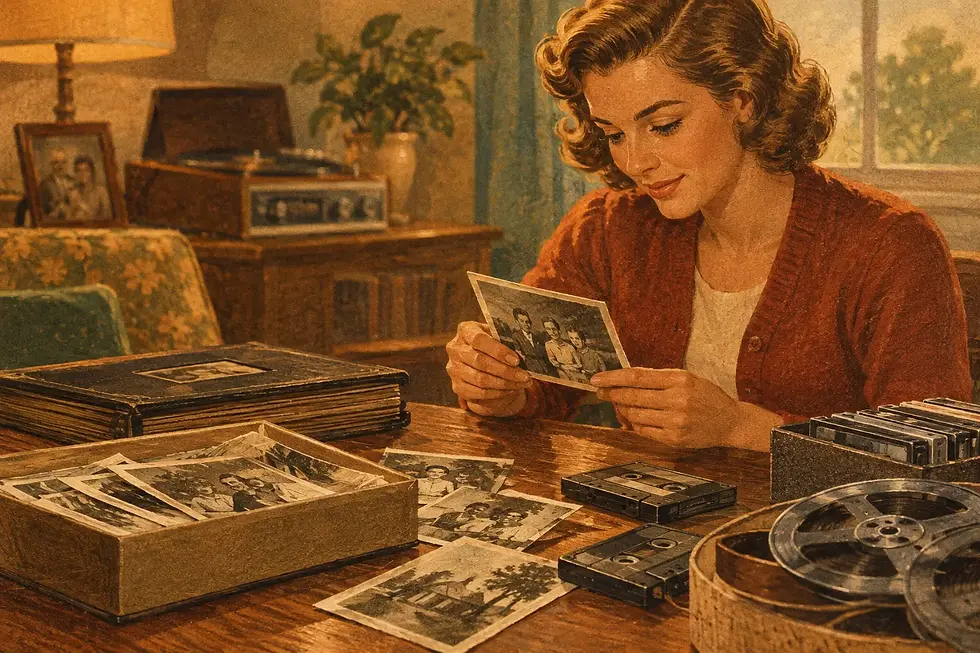
At this stage, families can add photographs, captions, letters, recipes, documents, or family-tree details if they wish. These additions are valuable, but they are not a requirement. Waiting until every photo is sorted can delay a project for years. Start with the stories. Pictures can be gathered as the book takes shape.
Finally, the material is professionally formatted into a readable book. A color PDF gives the family something immediate to save and share, while a printed hardcover can become a gift for children and grandchildren. The practical difference matters: a stack of recordings is easy to lose track of; a finished book invites people to sit down with it.
Preserve the sound of a loved one’s voice
Words on a page are precious, but they cannot fully capture a voice. The cadence of a father telling a joke, the gentle certainty of a grandmother offering advice, or the emotion that enters a sentence when someone speaks about a lost sibling all carry meaning.
That is why audio belongs alongside the written story whenever possible. QR codes in a book can allow readers to hear selected recordings on a phone or tablet. A grandchild can read a passage and then listen to the person who lived it tell it in their own voice. It is a small technical feature with a deeply human result.
Digital preservation matters too. Files kept on one laptop, old phone, or thumb drive are vulnerable to accidents and changing technology. A private family web page makes sharing easier, and long-term archival preservation gives the work a better chance of remaining available beyond the devices we use today.
Do not let perfection delay the project
Families often worry about getting every fact exactly right. Careful editing and research are worthwhile, especially with names, places, military records, and family relationships. Yet a legacy book is not a courtroom transcript. Memory is personal. Two siblings may remember the same Christmas differently, and both accounts may belong in the family record.
The important distinction is between correcting a clear factual error and flattening someone’s lived experience. If a storyteller says, "That was the coldest winter I can remember," the sentence does not need a weather report attached to it. It tells readers how that winter felt.
Another common concern is whether old family tensions should appear in the book. There is no single answer. Some stories benefit from gentle honesty, especially when they explain a turning point in a life. Other details may be too raw, too private, or simply not necessary for the intended readers. A skilled interviewer and editor can help a family make those decisions with dignity.
Give the storyteller control without giving them homework
The person whose story is being preserved should always have a say in what is included. They should be able to review the text, correct names, remove material they do not want shared, and decide who may receive the finished book.
Control does not mean handing them a complicated dashboard and asking them to learn new software. For many older adults, that approach turns a meaningful project into an exhausting chore. A phone conversation, a printed proof if preferred, and a patient person on the other end are often all that is needed.
This is the heart of a high-touch service. At Heritage Circle, the work is built around personal interviews and careful production rather than asking families to record themselves into an app. The storyteller gets to do the part only they can do: remember, reflect, and speak. Someone else handles the transcription, organization, formatting, and preservation.
Make room for the stories no one has asked about
The best questions are often ordinary ones. What did Saturday mornings look like? Who taught you to drive? What was your first apartment like? What did your parents do when money was tight? Which family saying still makes you smile?
These questions do more than fill pages. They preserve the texture of a life. Future readers may know the big milestones already, but they will treasure the small details: the brand of candy kept in a purse, the route walked to school, the music playing in a first car, the advice repeated at every goodbye.
You do not need to wait for a birthday, an anniversary, or a crisis to begin. Call the person whose stories you want to keep. Ask for one memory. Listen without hurrying them. That first conversation may become a book, and one day, it may become the voice your family is grateful it never lost.