How Do Seniors Make a Memory Book That Lasts?

A memory book rarely begins with a grand plan. More often, it starts with a photograph in a kitchen drawer, a story told at Sunday dinner, or a grandchild asking, “What was your first job?” If you have wondered, how do seniors make a memory book when writing feels daunting or technology feels like a chore, the answer is simpler than it may seem: start with conversation, not perfection.
The best memory books do not try to capture every date, every relative, or every event. They preserve the moments that sound like a real person: the way your mother made biscuits, the first car you could barely afford, the neighbor who always showed up when help was needed, the family rule everyone still repeats. Those are the details children and grandchildren remember.
Start With the Stories You Want to Keep
A memory book is not a school assignment. There is no required order, no minimum number of pages, and no prize for remembering every year correctly. Its purpose is to leave something true behind in your own words.
Many seniors find it easier to begin with a single chapter of life rather than “their whole story.” You might talk about growing up in your hometown, meeting your spouse, raising children, serving in the military, working a long-loved job, or the traditions that shaped your family. One good story often leads naturally to another.
It can help to think in scenes rather than facts. Instead of writing, “We moved to Ohio in 1968,” you might remember packing the station wagon, the rain on moving day, or how strange the new house smelled. Facts give a story its frame. Small details give it a heartbeat.
Choose a Shape That Feels Manageable
Some memory books follow a life from childhood to the present. Others are organized around themes, such as family recipes, lessons learned, favorite holidays, faith, work, military service, or love stories. A photo-centered book can work beautifully, too, with a few paragraphs beside each image.
There is no single right format. A chronological book may suit someone who enjoys telling a complete life story. A themed book may be gentler for someone who wants to focus on the memories that matter most. Even a short book of ten stories can become an irreplaceable family keepsake.
How Do Seniors Make a Memory Book Without Writing It Alone?
For many people, the hardest part is not remembering. It is facing a blank page. That is why speaking memories aloud is often the easiest path forward.
A family member can sit down with a notebook or voice recorder and ask one question at a time. Keep the setting comfortable: a favorite chair, a cup of coffee, an unhurried afternoon. The goal is not an interview that feels formal. It is a good conversation.
Questions that invite stories tend to work better than questions that ask for a date. “What did your childhood home feel like?” may bring out more than “Where did you live?” “What do you want your grandchildren to know about you?” can open a door that has been waiting a long time.
If a senior prefers privacy or does not want to burden a relative with the work, a guided interview service can be a meaningful alternative. Heritage Circle, for example, is built around personal phone conversations, with someone listening carefully, shaping the transcript lightly, and turning stories into a finished legacy book. The storyteller does not need to learn an app, type a manuscript, or manage a complicated dashboard.
That kind of support is especially valuable when the goal is to preserve a person’s natural voice. A polished book should still sound like the person who lived the life.
Gather Photos, Letters, and Everyday Treasures
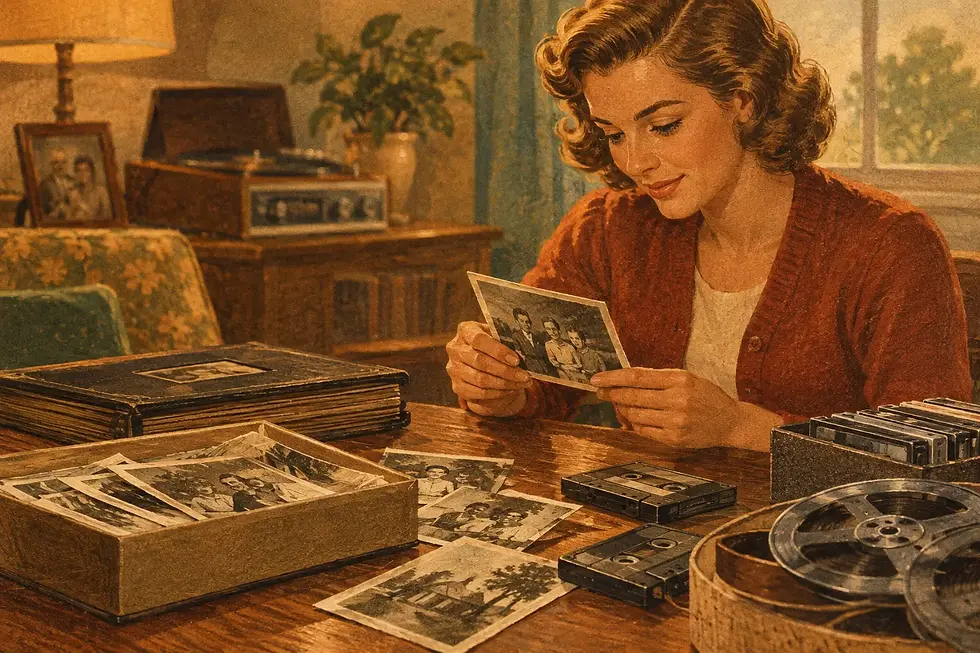
Photographs are often the spark that brings memories back. Do not worry if the family albums are incomplete, the pictures are faded, or names are missing from the back. A photo does not need perfect documentation to have meaning.
Choose images that help tell the story: childhood portraits, wedding pictures, family reunions, homes, workplaces, beloved pets, vacations, and ordinary snapshots from daily life. A picture of a worn porch swing or a family kitchen may say more to future generations than a formal portrait ever could.
Letters, recipe cards, report cards, newspaper clippings, service records, and handwritten notes can also add personality. Use only what genuinely belongs in the story. A memory book should feel generous and welcoming, not crowded like an attic.
When possible, add a short caption to photos. Include names, approximate dates, places, and a sentence about why the picture matters. “This was taken after Dad came home from Korea” is far more valuable than “Dad, 1953.” Future readers will be grateful for every clue.
Do Not Wait for Perfect Materials
Families sometimes postpone a memory book because they are still searching for missing photographs or trying to settle every family detail. That can delay the project for years.
Begin with what is available now. You can always make a second volume, add a family photo album later, or preserve newly discovered materials separately. The stories you can record today are more important than the pictures you may find someday.
Keep the Voice Honest and Human
A good memory book is not a résumé. It does not need to present a flawless life. In fact, a little honesty is often what makes it most valuable.
People can write about difficult seasons with care and without sharing more than they wish. A job loss, a move, an illness, or a family disagreement may be part of the story, but every author has the right to decide what remains private. The book belongs to the storyteller first.
There is also room for humor. Perhaps your first cooking attempt was a disaster. Perhaps the family vacation involved a flat tire, a tent that leaked, and everyone laughing about it years later. These are not minor memories. They are often the stories grandchildren ask to hear again.
Accuracy matters, but memory is not a courtroom. If you are unsure whether something happened in 1959 or 1960, say “around that time” or leave the year out. It is better to preserve a living story than to let uncertainty stop it altogether.
Make It Easy for Family to Read and Keep
Once stories and materials have been gathered, the final presentation matters. Large, readable type, clear chapter breaks, and well-placed photos make a book inviting for older readers and younger family members alike. A professionally formatted PDF can be easy to share with relatives across the country, while a printed hardcover gives the project the satisfying permanence of a real book on a shelf.
Consider preserving audio, too. Hearing a grandfather describe his childhood in his own voice can become one of a family’s most treasured possessions. Audio clips can be stored alongside the written book, and some projects include QR codes that let a reader hear the story while holding the page.
Digital copies are useful, but they deserve thoughtful preservation. Save more than one copy, and make sure a trusted family member knows where it is kept. Print books, digital files, and preserved audio each serve a different purpose. Together, they give a family more than one way to remember.
Let the Book Be a Gift, Not a Burden
A memory book does not have to be finished by a holiday, a birthday, or a particular anniversary. Those dates can be lovely motivation, but rushing can make a meaningful process feel heavy. A few relaxed conversations may produce better stories than a weekend spent trying to force a complete autobiography.
If a parent or grandparent hesitates, reassure them that they do not have to “be a writer.” They only need to be themselves. Someone can help with the questions, the recording, the photos, the editing, and the finished pages.
Years from now, the people who receive this book will not be judging its grammar or counting its photographs. They will be listening for a familiar voice, finding a piece of themselves in a family story, and feeling grateful that someone took the time to leave the door open.