
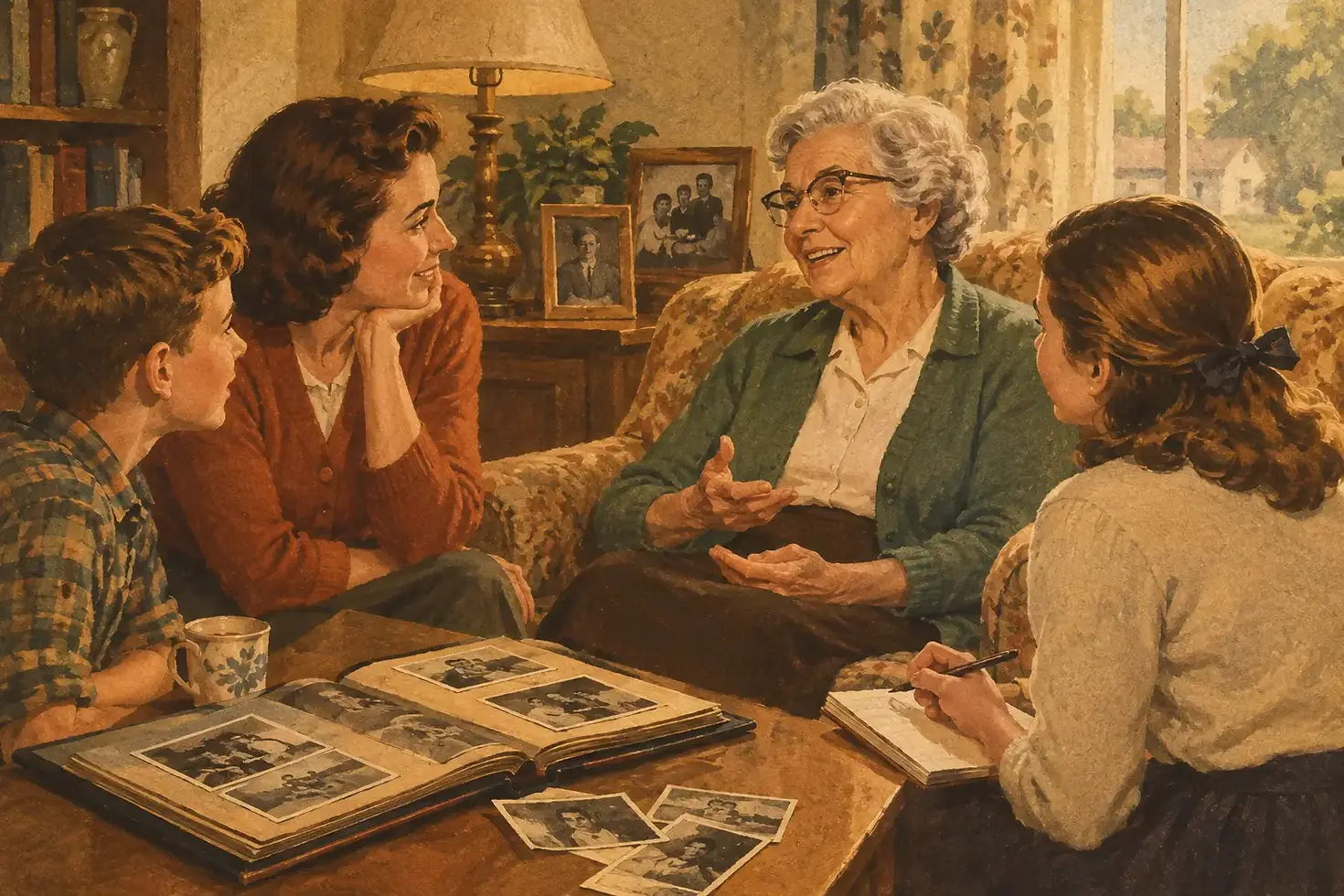
Family History Interviews That Feel Like Home

The stories families treasure rarely begin with a formal announcement. They surface while someone is peeling apples, looking through an old photograph, or remembering the first house they bought for $8,000. A good conversation makes room for those moments. That is why family history interviews can become one of the most meaningful gifts a family gives itself: they preserve not only the facts of a life, but the voice, humor, values, and small details that facts alone cannot carry.
For many parents and grandparents, the idea of “writing a memoir” feels like homework. They may worry that they are not good writers, that their memories are too ordinary, or that they will not know where to begin. An interview offers a kinder path. There is no blank page staring back at them. There is simply a caring person asking, listening, and following the thread.
Why Family History Interviews Matter
A date of birth, a wedding announcement, and a list of military service can tell future generations what happened. They cannot explain why a young couple chose one town over another, what a father was like when he laughed too hard, or how a grandmother managed a household during a difficult season.
Those are the details children and grandchildren return to. They give a family its texture. They also correct a common misunderstanding: a life story does not have to include fame, extraordinary wealth, or a dramatic historical event to be worth preserving. Raising children, building a career, caring for a neighbor, surviving a loss, or learning to begin again are all parts of a life that deserve to be remembered.
The sound of a loved one’s voice matters, too. A printed book is lasting and easy to share, but an audio recording captures a familiar laugh, a pause before an emotional memory, and the particular way someone tells a story. Keeping both the written narrative and the spoken voice gives a family something richer than either format alone.
The Best Interviews Feel Like Conversations
The strongest interviews do not feel like a quiz show or a deposition. They move naturally, with room to wander a little. Sometimes the most revealing answer comes after a question that seems simple: “What did your kitchen smell like when you were growing up?”
A thoughtful interviewer listens for the stories beneath the first answer. If someone says, “My father was a quiet man,” the next question might be, “How did he show that he cared?” That gentle follow-up often brings out a memory of a repaired bicycle, a handwritten note, or a long drive home in silence after a hard day.
There is a balance to strike. A family history interview should be guided enough to cover the important chapters, but loose enough to let a person be themselves. Some people begin with childhood and move forward year by year. Others start with their proudest accomplishment, their courtship, or a memory that has been on their mind lately. There is no wrong doorway into a life.
Questions That Invite Real Stories
Broad questions usually work better than questions that can be answered with yes or no. “Tell me about the home you grew up in” gives someone room to describe the people, routines, sounds, and feelings that shaped them. “What do you remember about your first job?” may lead to a funny story about a difficult boss or a lesson they carried for decades.
It also helps to ask about meaning, not just events. After discussing a move, a marriage, a career change, or a loss, ask, “What did that period teach you?” This is where family wisdom often appears. Future readers may not face the exact same circumstances, but they will recognize courage, patience, faith, loyalty, and the ability to keep going.
A few well-placed questions about family traditions can be especially valuable. Ask what holidays looked like, which recipes mattered, what sayings were repeated in the household, and what was expected of children. These memories often become the bridge between generations who never had the chance to meet.
Make the Process Comfortable for the Storyteller
Comfort is not a small detail. It is the foundation of a good interview. Many older adults have plenty to say once they know they will not be rushed, corrected, or judged for forgetting a date.
Phone interviews can be a wonderful option because they remove the fuss of cameras, logins, and equipment. A storyteller can sit in a favorite chair with a cup of coffee, a few photographs nearby, and no need to learn a new app. For some families, an in-person conversation is ideal. For others, distance or busy schedules make the phone a more realistic choice. What matters most is a calm setting and an attentive listener.
Shorter sessions are often easier than trying to tell an entire life story in one afternoon. An hour of focused conversation can be plenty. It gives the storyteller time to rest and reflect, and it lets memories return between sessions. A person may hang up and suddenly remember the name of a childhood neighbor, the song played at a wedding, or the exact words their mother used to say.
If a memory is painful, there is no need to press. A respectful interview gives the storyteller control. They can skip a question, return to it later, or decide that a subject belongs only within the family. The goal is not to extract every detail. It is to create an honest record that feels right to the person sharing it.
From Conversation to a Lasting Family Record
Recording an interview is only the beginning. Without transcription, editing, and preservation, even a wonderful conversation can end up as a file no one can find or play years from now.
A carefully prepared legacy book turns spoken memories into something readable and durable. Light editing can remove repeated phrases and clarify the flow without sanding away personality. The storyteller should still sound like themselves. Their favorite expressions, sense of humor, and point of view are not mistakes to be corrected. They are part of the inheritance.
Photos add another layer when available. A portrait of a young couple, a snapshot of the old family farm, or a faded image from military service can help readers enter the story. Still, photographs are not required. A meaningful book can begin with nothing more than a conversation and a willing voice.
At Heritage Circle, the process is intentionally personal: spoken interviews are transcribed and shaped into a color PDF book, while audio can be accessed through QR codes and preserved alongside a private family page. The point is not to give families another dashboard to manage. It is to do the careful production work for them, so the storyteller can focus on telling the truth of their life.
When Should Your Family Begin?
Sooner is usually better, but “soon” does not mean creating pressure. A birthday, anniversary, retirement, new grandchild, or family reunion can provide a natural reason to begin. So can a quiet Tuesday when someone says, “I was just thinking about my mother.”
Do not wait until you have every photograph labeled or every family date confirmed. Those things can be sorted out later. Start with the stories that are alive now. Names and dates are useful, but the sound of a loved one recalling how it felt to leave home, fall in love, or hold a newborn child is irreplaceable.
A family history interview is not a performance, and it does not need to produce a perfect version of the past. It is an act of attention. Sit down with someone you love, ask a real question, and give their answer the time it deserves.


