
DIY Memoir Apps Versus a Human Interviewer

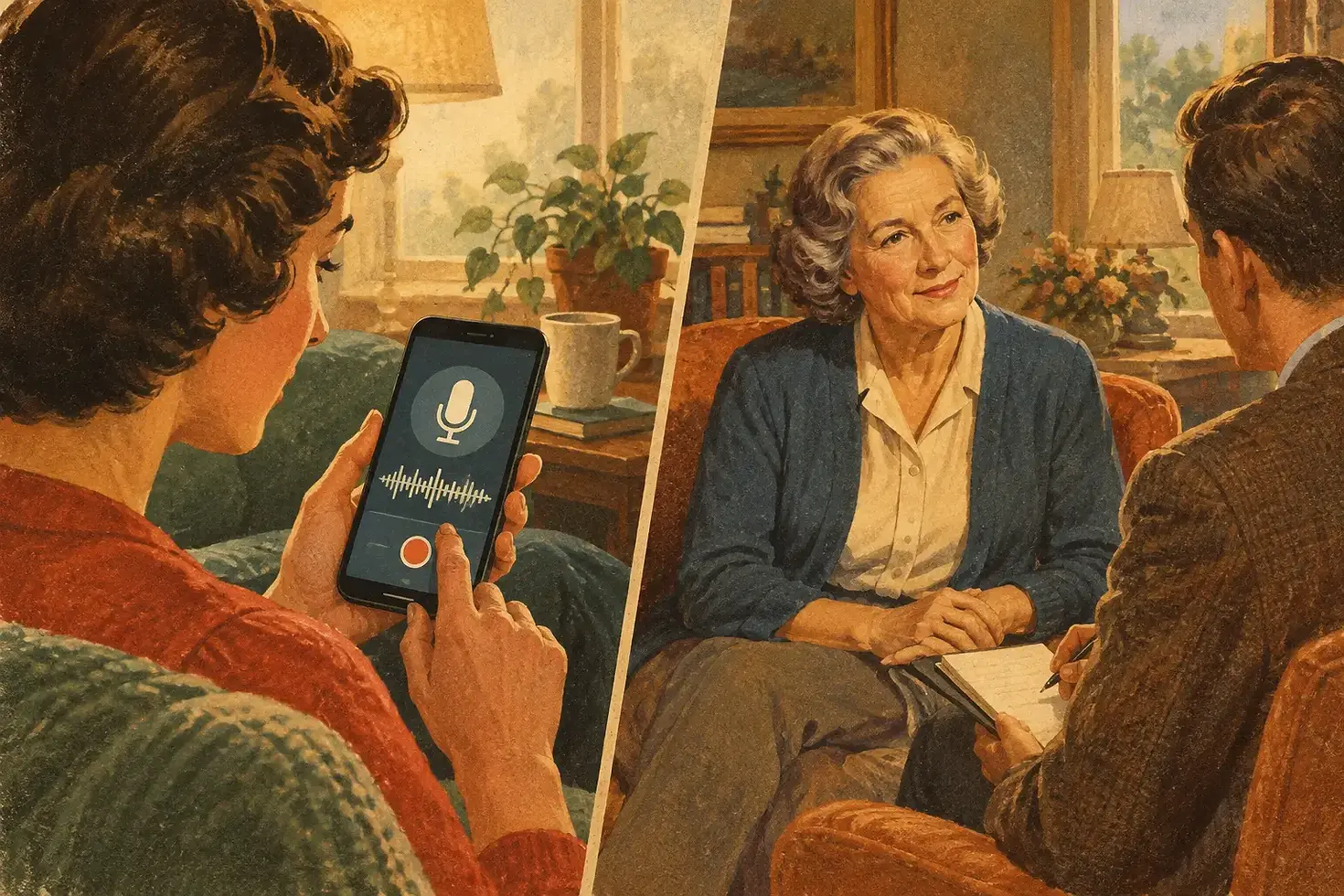
A grandmother may have fifty years of family stories in her memory, yet freeze when an app opens with a blinking cursor and asks, “Tell us about your childhood.” That small moment explains much of the choice around DIY memoir apps versus interviewer-led storytelling. Both can preserve memories. But they ask very different things of the person whose life is being recorded.
A memoir app puts the storyteller in charge of prompts, recording, organizing, revising, and often finishing the project. An interviewer brings patience, follow-up questions, and the gentle structure that helps a real conversation unfold. Neither choice is wrong. The better choice depends on whether your loved one enjoys working independently with technology or would rather simply sit down and be heard.
What DIY memoir apps do well
Memoir apps can be useful for a person who is comfortable with a smartphone or computer, enjoys writing, and likes setting their own pace. Many offer daily or weekly prompts such as “What was your first job?” or “Describe a favorite holiday.” Some allow photos, voice recordings, and family sharing.
For a self-starter, this can feel satisfying. The work happens in small pieces, often whenever inspiration strikes. An adult child can also use an app to gather short answers from several relatives at once, which may be especially helpful for a reunion, a milestone birthday, or a family photo project.
The trade-off is that the app becomes another task to manage. Someone must remember the prompts, open the program, type or record an answer, correct mistakes, label photos, and decide what belongs in the final story. Even a beautifully designed app cannot notice when a person has mentioned an old neighbor, a wartime letter, or a family move that deserves a second question.
A prompt may ask, “What was school like?” A human listener can say, “You mentioned walking two miles there. Who did you walk with?” That is often where the story lives.
Why an interviewer draws out a fuller memoir
Most people do not speak about their own lives in neat chapters. They remember a smell from a kitchen, then a sister’s laugh, then a job they took after high school. A skilled interviewer knows that this is not a problem to be corrected. It is the natural shape of memory.
An interviewer can make room for pauses and can recognize when a subject should be approached carefully. They can ask for names, dates, places, and the small details that make a story vivid without turning the conversation into a test. Just as importantly, they can move on when a memory is tender or private.
This approach is especially valuable for older adults who say, “My life was ordinary,” or “I do not know what I would talk about.” Usually, they have plenty to say. They simply need someone genuinely interested enough to ask. The first telephone, the family business, a difficult move, the person who taught them to drive, the values that carried them through hard years - these details rarely appear all at once because a screen asked for them.
There is also a practical kindness in being interviewed. The storyteller does not need to learn new software, hunt through settings, or wonder whether they are doing it correctly. They can make a cup of coffee, answer the phone, and talk. For families helping a parent or grandparent, that lower burden can be the difference between a project that begins and one that actually gets finished.
DIY memoir apps versus interviewer-led books
When comparing DIY memoir apps versus an interviewer, it helps to look beyond the first recording. A memoir is not only the act of remembering. It is also the work of shaping, preserving, and sharing those memories in a form a family can return to.
With an app, the storyteller or family usually remains responsible for the editorial decisions. Which stories should come first? Should repeated memories be combined? Are names spelled correctly? How will the writing be turned into something relatives can read years from now? Some families enjoy that work. Others find that the recordings and answers remain scattered in a dashboard, unfinished but too meaningful to abandon.
An interviewer-led service carries more of that weight. The conversation is recorded and transcribed, then lightly edited for clarity while keeping the storyteller’s natural voice. The result can be organized into a readable book rather than a collection of disconnected answers. This is not about making someone sound like a professional author. It is about making sure a grandchild can follow the story and still recognize the person speaking.
Voice matters, too. A written memory is precious. Hearing a loved one tell it in their own cadence can be irreplaceable. The little pauses, the chuckle before a favorite story, the emphasis on a name - audio holds part of a person that polished prose cannot. If recordings are included with the finished book through QR codes, readers can move from the printed page to the original voice without asking the storyteller to become their own audio producer.
The question is not whether technology is good
Many families worry that choosing a human interviewer means giving up digital access. It does not have to. Technology can serve the story quietly in the background.
A thoughtful legacy project may include a color PDF for easy sharing, a private family web page, and carefully preserved digital files alongside a printed book. Long-term preservation matters because an old phone, a forgotten password, or a discontinued app should not be the only home for a family’s history. A book on a shelf and files stored with care give the story more than one chance to endure.
Heritage Circle takes this human-first approach by conducting personal phone interviews, preparing a professionally formatted legacy book, and preserving the completed work digitally as well as in print. The goal is not to make families more dependent on a platform. It is to leave them with a meaningful record they can hold, hear, and pass along.
When a DIY app may be the right fit
A DIY tool can be a fine choice when the storyteller already likes journaling, wants complete control over every word, and has the time and comfort to keep a project moving. It can also work well for short, specific projects: collecting favorite recipes, gathering a few memories for an anniversary, or inviting several relatives to answer the same question.
It may be less suitable when the person dislikes technology, has arthritis or vision limitations that make typing tiring, or becomes discouraged by open-ended prompts. It can also fall short when a family hopes for a cohesive life story but no one has the time to conduct interviews and assemble the material afterward.
There is no prize for doing a memoir alone. A life story is not less authentic because someone helped ask the questions, transcribe the words, or arrange the pages. In fact, support often allows the storyteller’s own personality to come through more clearly.
Choosing with your loved one, not for them
If you are considering a memoir project for a parent or grandparent, begin with a simple conversation. Ask whether they would rather write privately, respond to prompts, speak into a recorder, or talk with a warm and attentive person. Their answer matters more than the newest feature on any platform.
You can also start small. Invite them to share one story they would want a great-grandchild to know: how they met their spouse, what their neighborhood was like, what they learned from their parents, or a moment they are proud of. Notice what happens next. If the story grows as someone listens, an interview may be the gentlest path forward.
The finest legacy projects do not demand that a loved one become a writer, a technician, or a project manager. They give that person a comfortable place to speak, and give the family a way to keep listening long after the conversation ends.


