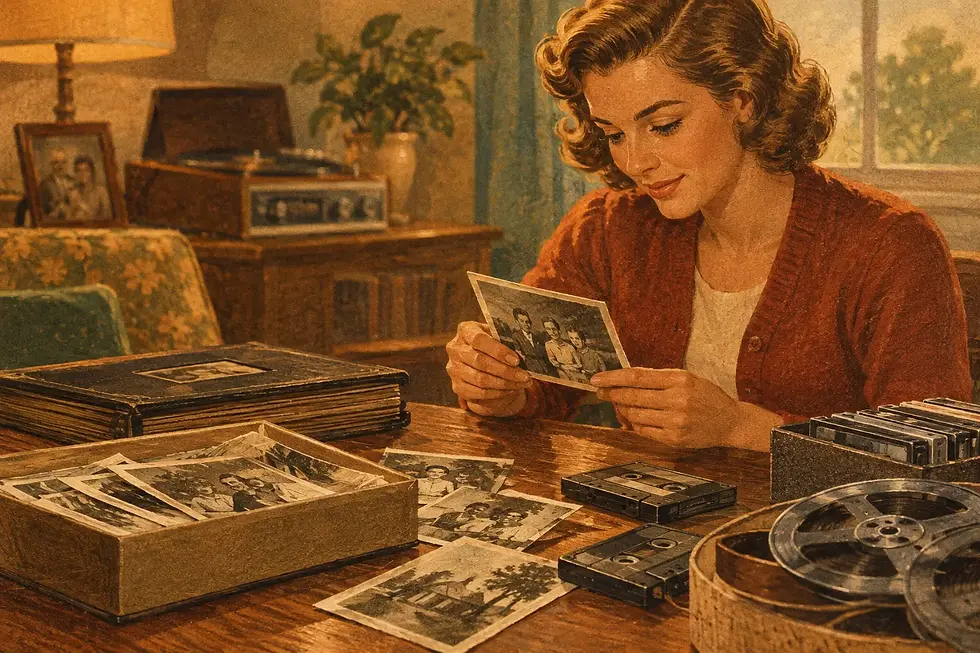
Digital Preservation for Family Archives That Lasts

A shoebox of photographs can survive for decades in a closet. A phone full of pictures, voice memos, and text messages can disappear with one broken screen, forgotten password, or account that quietly closes. The goal of digital preservation for family archives is not simply to put old things on a computer. It is to make sure the people, voices, and memories your family cares about can still be found, understood, and enjoyed years from now.
That may sound technical, but it does not need to become a second career. A thoughtful family archive is less about having the newest gadget and more about making a few good decisions while the stories are still close at hand.
What digital preservation really means
Scanning a photograph is a useful first step. Preservation goes further. It means creating good-quality digital copies, naming them clearly, keeping them in more than one place, and leaving enough context that a grandchild will know who is pictured and why the moment mattered.
The same is true for family stories. A typed memory is valuable. An audio recording can be even more moving, because it preserves the laugh before the punchline, the pause when someone remembers a difficult year, and the familiar voice a family may ache to hear someday. When possible, preserve both: the spoken story and a readable version of it.
Digital files are wonderfully easy to share, but they are not automatically permanent. Hard drives fail. Computer folders become mysteries. Cloud services change their rules. Preservation is the gentle habit of planning for those realities rather than hoping they never arrive.
Start with the stories that cannot be replaced
Many families begin by trying to digitize every photograph they own. It is an understandable impulse, and it can become overwhelming very quickly. Start instead with the items that would hurt most to lose or that need explanation from someone who is still able to provide it.
That might be the wedding album with names written on the back, a stack of letters from military service, a grandmother's recipe card in her handwriting, or the photographs from a family farm that no longer exists. It may be a parent's account of how they met, how they got through a hard season, or what they hope their grandchildren remember about them.
Ask simple questions as you work: Who is this? When was it? Where were they? What happened just before or after the picture was taken? Why has this been kept? A few sentences of context can turn an appealing old image into a piece of family history.
For older relatives, conversation is often the easiest doorway. They do not need to sit down and write chapters. A patient interviewer can follow their natural train of thought, ask a warm follow-up question, and let the memories arrive in their own time. That approach usually produces the details a written questionnaire misses: the smell of a grandmother's kitchen, the name of a first-grade teacher, the small kindness that changed a life.
A practical plan for digital preservation for family archives
The best plan is one your family will actually maintain. Begin by gathering a small group of high-priority items and making clear digital copies. For photographs and documents, use a scanner when you can. A phone camera can work well for quick projects, especially in bright, even light, but make sure the image is square, sharp, and free of glare.
Save original scans at a high resolution. You can always make a smaller copy for texting or posting, but you cannot add detail back later. For audio, keep the original recording in addition to any edited version. For written stories, save a PDF for easy reading and a document file that can be updated if needed.
Then give files names that a person can understand without opening each one. “IMG4839” is not much help to anyone. “1958SmithFamilyPicnicOhio” is far better. A consistent pattern using the year, family name, event, and location can make a growing collection much easier to search.
It also helps to keep a simple inventory. This can be a document or spreadsheet with columns for the item name, date, people involved, location, source, and a short note about its significance. Do not worry about creating a museum catalog. The point is to spare your family a future guessing game.
Keep more than one copy
One copy is a convenience. Multiple copies are preservation. A sensible approach is to keep files on your computer or an external drive, in a reputable cloud storage account, and in one additional location outside your home. That outside copy protects against fire, flood, theft, and the familiar problem of a computer that simply decides it has had enough.
Check those copies from time to time. Open a few files. Make sure the drive still works and that you can sign in to the account. This small check is far easier than discovering a problem after a family member has passed away.
Preserve the meaning, not only the file
A photograph without a caption may be beautiful, but it can become anonymous in a generation or two. Whenever possible, attach the story to the item. Add names, dates, places, and relationships in a caption document, photo description, or family history book.
If the date is uncertain, say so. “Around 1947, possibly at the Johnson farm” is much more useful than silence. Honest uncertainty is part of good family history. It leaves room for future relatives to add what they know without turning a guess into a permanent fact.
Make room for voice and personality
There is a difference between preserving information and preserving a person. A family tree can tell descendants that someone was born in 1934. A conversation can tell them that he delivered newspapers before school, saved up for his first car, and still talked about the neighbor who taught him how to drive.
Audio recordings are especially meaningful for families with young children or grandchildren. Years from now, hearing a loved one tell a story in their own voice may matter as much as the story itself. If you record interviews, choose a quiet room, keep the device nearby, and let the speaker finish a thought before moving on. The imperfect moments are often the most human ones.
A professionally shaped legacy book can bring these materials together without sanding away the speaker's personality. The book gives a family something comfortable to hold and pass around, while QR codes or other audio access can connect readers to the original voice. Heritage Circle uses this kind of combination because families should not have to choose between the permanence of a book and the warmth of hearing someone speak.
Decide what should stay private
Not every family memory belongs on a public website or in a group text. Before sharing an archive, consider who is living, what information is sensitive, and whether a story was told in confidence. Medical details, home addresses, painful conflicts, and financial information may need careful handling.
You can create different versions for different purposes. A private family collection may contain fuller notes, while a shareable book or web page includes the stories everyone is comfortable passing on. This is not secrecy. It is respect.
Also think about who will be responsible for the archive later. Let at least one trusted family member know where files are stored, how to access them, and what you hope will happen to the collection. A beautifully organized folder is of little help if nobody knows it exists.
Do not wait for the perfect moment
Families often postpone this work because they imagine it requires months of scanning, sorting, and technical know-how. Sometimes a large project does require that much care. But a meaningful beginning can be as simple as one recorded conversation, ten labeled photographs, or a folder containing a parent's favorite stories.
The right pace depends on your family. Some people enjoy organizing every detail. Others would rather tell the stories and let someone else handle transcription, editing, design, and file management. Both are valid. The important thing is not to leave the memories trapped in a format that only one person understands.
A preserved family archive is a quiet gift. It tells the next generation, “These lives were here. These voices mattered. You come from somewhere.” Start with one memory worth keeping, and give it a safe place to live.