Why Hire Someone to Write Family History?

A family history rarely disappears because no one cared. It disappears because the people who hold the stories are busy, modest, uncertain where to begin, or simply tired of being asked to use another app. If you are considering whether to hire someone to write family history, you are not handing off a chore. You are giving important memories the time, attention, and shape they deserve.
For many families, this decision begins with a familiar moment: a grandchild asks about an old photograph, a parent mentions a childhood home that no longer stands, or a beloved relative’s health changes. Suddenly, “we should write this down someday” feels less like a good idea and more like a promise that should be kept.
A family history needs more than facts
Dates, names, and places matter. They help future generations understand where they came from. But the parts people remember most are often the details that never make it into a family tree: how Grandma stretched a Sunday roast to feed unexpected guests, why Dad chose his first career, what it felt like to move across the country with two suitcases, or the joke everyone told at the kitchen table.
A good family history holds both kinds of truth. It preserves the record and the feeling.
That is harder than it sounds. Most people do not speak in neat chapters. Memories arrive in flashes. One story leads to another. A person may remember the name of a neighbor before recalling the year they moved, or pause for a long time before describing a difficult season. A skilled interviewer knows that these are not mistakes to correct. They are often the path to the real story.
What happens when you hire someone to write family history
The best professional family historians do not simply send a questionnaire and wait for answers. They make the process feel like a conversation with someone who is genuinely interested.
Usually, the work begins with a gentle planning conversation. What kind of project does your family want? A life story centered on one parent or grandparent? A wider history that includes several branches of the family? A book built around photographs, military service, immigration, a family business, faith, recipes, or a treasured home?
Then come the interviews. For many older adults, a phone conversation is more comfortable than typing into a screen or recording themselves alone. There is no blank page staring back. There is no pressure to have every date correct on the spot. A thoughtful interviewer can ask follow-up questions, slow down when a memory is meaningful, and return to an earlier topic when a new detail surfaces.
Afterward, the spoken stories are transcribed and shaped into readable prose. The goal is not to make a loved one sound like someone else. It is to organize their memories so children and grandchildren can follow the thread of a life while still hearing the speaker’s personality, humor, values, and way of telling a story.
The real value is careful listening
Many people assume they need to prepare before telling their story. They worry they do not have an extraordinary life, cannot remember enough, or will be embarrassed by an imperfect timeline. Those worries are understandable, and they are usually unnecessary.
Ordinary life is where family meaning lives. A first job, a favorite teacher, a hard-earned house, a long marriage, a sibling rivalry, a holiday tradition, or a lesson learned from a parent can become the part of a book that someone reads again and again.
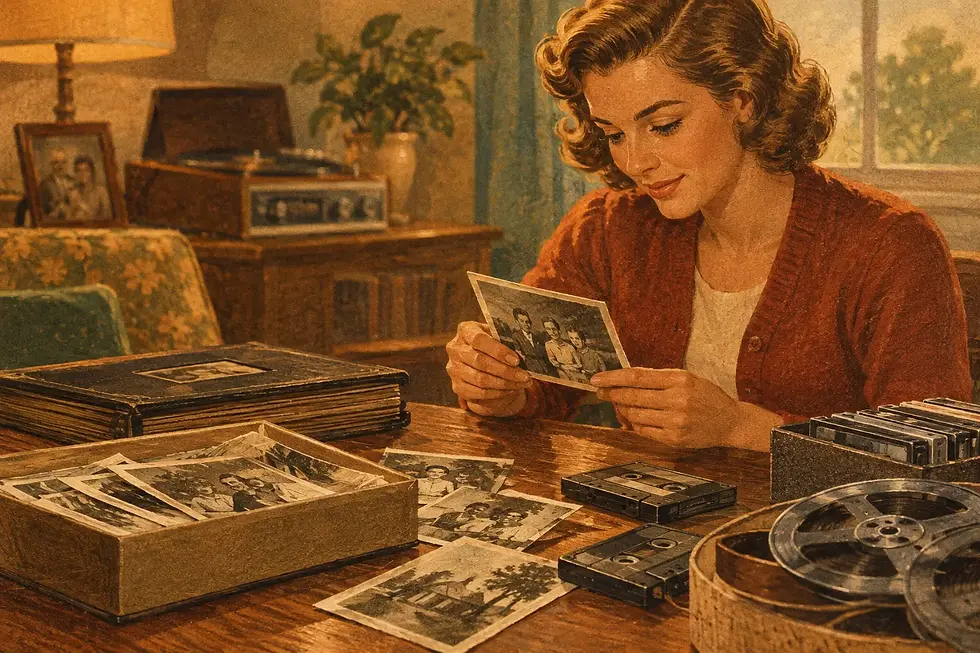
Professional help is especially useful when a family has a lot of material but no clear way to organize it. Perhaps there are boxes of photographs, handwritten letters, old recipes, military papers, or notes from genealogy research. Those items can be wonderful starting points, but they can also feel overwhelming. An experienced writer or legacy publisher can help decide what belongs in the story, what needs a caption or context, and what can be saved for a separate collection.
This does not mean every project needs to become a 300-page historical manuscript. Sometimes a focused book of 40 or 60 pages is exactly right. The right scope depends on the family, the available material, and what the storyteller has energy for. A shorter, finished book is far more valuable than an ambitious project that never leaves the kitchen table.
A written story is stronger when the voice remains
Words on a page are a gift. Hearing the person behind those words can be an even deeper one.
When possible, ask how interview recordings will be preserved and shared. Audio holds things print cannot: a familiar laugh, a pause before a tender memory, an accent, the rhythm of a favorite saying. Years from now, those small sounds may matter as much as the story itself.
At Heritage Circle, spoken interviews can become a professionally formatted color PDF book, with QR codes that let family members hear the original audio. The book can also be shared privately online and preserved digitally for the long term. For families who want a physical keepsake, hardcover printing is available at cost.
That combination is useful because family members do not all connect in the same way. One person may sit down with the book on a quiet afternoon. Another may scan a code on a phone and hear a grandparent tell the story in their own voice. Both experiences help a family feel closer.
Questions to ask before choosing a writer or service
Before you commit, have a conversation about the process. You are trusting someone with personal memories, and the relationship should feel respectful from the beginning.
Ask who will conduct the interviews. Will it be the same person who helps shape the book? Ask whether you or your loved one can review the draft and correct details before it is finalized. Ask what happens to the recordings, transcripts, photographs, and finished files. A clear answer about privacy and long-term preservation is a sign of care.
It also helps to understand what is included. Some services focus on writing only. Others can help with photo restoration, extended interviews, family tree books, genealogy materials, albums, or a full manuscript. There is no single right package. The important question is whether the service can meet your family where it is, rather than forcing your story into a preset template.
Finally, pay attention to how the person speaks about editing. Light editing should make a story easier to read without sanding away the character of the storyteller. A family history should not sound like a corporate biography. It should sound like your family, at its best and most recognizable.
When it is worth starting now
There may never be a perfect time. Holidays are busy. Retirement can be busy, too. Some people feel they need to sort every photograph first or finish their genealogy research before they begin. In most cases, starting with a conversation is wiser.
Stories can be added to over time. Photos can be identified later. A cousin may remember a name you have forgotten. But the opportunity to hear a loved one tell a story in their own words is more fragile. Beginning now does not require urgency or fear. It is simply an act of attention.
If you are helping a parent or grandparent, make the invitation simple: “I would love to hear more about your life, and I would love for the children to know these stories someday.” That is gentler than asking them to write a book. And it is often much closer to what you truly mean.
The finished family history may become a birthday gift, an anniversary present, or a book passed around at a reunion. More quietly, it becomes proof that a life was noticed. Long after the names and dates have been entered into a family tree, someone will open those pages, hear a familiar voice, and understand a little more about where they belong.