How to Preserve Family Stories Well

A lot of family history disappears in ordinary moments. It goes with the uncle who always told the best stories at Thanksgiving, the grandmother who knew exactly why the family left one town for another, the parent who says, "Oh, that old story? It’s nothing." Then one day, the person is gone, or the details get fuzzy, and everyone realizes that what felt permanent was actually fragile.
That is why people ask how to preserve family stories. They are not usually asking for a writing exercise. They are asking how to keep a voice, a personality, a set of values, and the small details that make a family feel like itself.
How to preserve family stories without making it a chore
The hardest part is not caring enough. The hardest part is friction. Many families begin with good intentions, then stall out because the process feels too technical, too time-consuming, or too much like homework.
If you want this to happen, make it easy on the storyteller. That usually means not handing them a blank document and saying, "Start from the beginning." For most people, especially older adults, that is an excellent way to get no stories at all.
A better approach is conversation. People remember more when they are speaking with someone who knows how to listen, ask a gentle follow-up question, and give them time to wander a little. Family stories rarely come out in neat chapters. They come out sideways. One memory leads to another. A joke turns into a lesson. A simple question about a first job opens up a whole era of life.
That is also why recordings matter. When stories are spoken, you keep the pacing, the laughter, the pauses, and the phrases a person always uses. A transcript can preserve the words, but audio preserves presence. If you can save both, do both.
Start with the stories that would hurt to lose
Not every memory has to be captured at once. In fact, trying to cover everything can freeze a project before it begins. Start with the stories your family would miss most if they were never told again.
That might be the story of how your grandparents met, why the family moved across the country, what life was like during military service, how a business was built, or what holidays looked like when the storyteller was young. It may also be less dramatic than that. Some of the most cherished stories are about recipes, nicknames, neighborhood characters, church picnics, first cars, and the little rules of family life.
A helpful question is, "What do the grandchildren not know yet?" Another is, "What does everyone assume somebody will tell later?" That second question catches a lot of endangered history.
If the storyteller feels overwhelmed, keep the first session narrow. Pick one season of life, one relationship, or one turning point. A focused start builds confidence and often leads naturally to more.
Good questions beat perfect timelines
People often think they need a full chronological plan. Sometimes that helps, but it is not required. What matters more is asking questions that open memory.
Questions like "What was your mother like when no one else was around?" or "What did home smell like when you were a child?" often bring richer answers than "What happened in 1958?" Facts matter, but texture is what makes a story live.
It also helps to ask about values, not just events. What did your father believe about work? What did your grandmother do when money was tight? What mistakes taught the biggest lessons? Families do not pass down only information. They pass down ways of seeing the world.
Choose a format your family will actually keep
One of the quiet mistakes families make is saving stories in a form that is easy to create but hard to revisit. A random folder of phone recordings may technically preserve something, but it does not invite future generations in.
A good family story archive usually includes a few layers. First, there is the spoken interview or recording. Second, there is a clean transcript or edited narrative that people can read comfortably. Third, there are supporting materials such as photographs, captions, dates, and names. When those pieces are gathered into a finished book or organized digital collection, the stories stop feeling temporary.
Print still matters here. A physical book can sit on a coffee table, get passed around at reunions, and become part of the home. Digital copies matter too, especially for sharing with relatives in different places and for long-term backup. It is not either-or. For most families, the strongest answer is both.
There is also a dignity question. Family stories deserve better than a pile of loose notes. A thoughtfully formatted book or archive tells the storyteller, and everyone who comes after, that this life was worth preserving carefully.
Photos help, but they are not the whole story
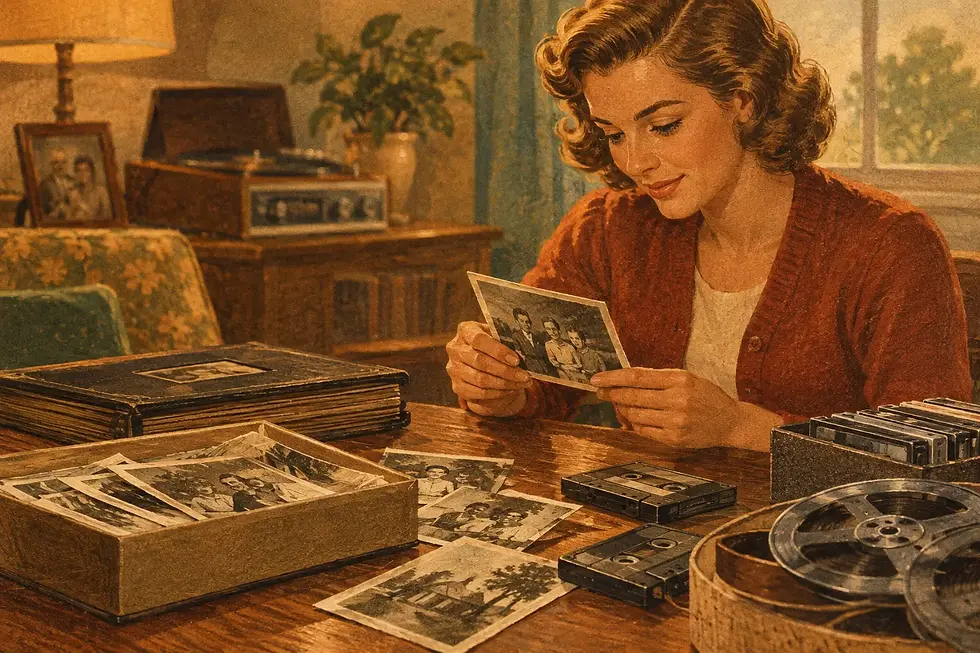
Many people start with a box of pictures, which makes sense. Photos are wonderful memory triggers. They help people remember names, places, clothing, cars, kitchens, and the shape of daily life.
But photos alone are not enough. A grandchild can look at a picture and still have no idea why it mattered. Who took the photo? What had just happened? Who was left out of the frame? Why was that day remembered for fifty years?
The strongest projects pair images with narration. Even a modest caption can turn a mystery into meaning. A fuller story can turn an old photograph into a family touchstone.
This is also where some editing is helpful. Raw material has value, but readers benefit from gentle organization. Stories should sound like the person who told them, not like a machine straightened them into blandness. The goal is clarity without losing the speaker’s character.
The best method depends on the person telling the story
There is no single right method for how to preserve family stories because families are different. Some storytellers enjoy being interviewed by a relative. Others hold back because they do not want to burden their children, or because family dynamics make honesty harder.
Some people are comfortable with a recorder on the table. Others open up more over the phone, where they feel less self-conscious. Some want a short keepsake. Others are ready for a fuller life history with photos, documents, and family tree material.
This is where outside help can make a real difference. A skilled interviewer knows how to draw out memories without rushing, how to shape spoken material into readable prose, and how to produce something polished enough to last. Just as important, an experienced guide removes the technology barrier. That matters more than many families realize.
For older adults especially, a project is more likely to happen when it does not require learning new software, managing uploads, or staring at prompts on a screen. Human support is not a luxury in this kind of work. Often, it is the reason the stories get preserved at all.
At Heritage Circle, that human-first approach is the point. The work begins with conversation, then moves carefully through transcription, editing, formatting, audio preservation, and long-term access, so the family is not left trying to turn raw memories into an heirloom on their own.
Preserve the voice, not just the facts
Families often think they need a perfectly accurate record of every date and detail. Accuracy is valuable, of course. Names should be checked. Captions should be as correct as possible. But if you wait for every uncertainty to be resolved, you may lose the living voice in the process.
Memory is human. Sometimes a person remembers the feeling of an event more clearly than the year. That does not make the story useless. In many cases, emotional truth is what future generations treasure most.
It is fine to note uncertainty where needed. "I believe this was around 1962" is perfectly respectable. What matters is preserving the person’s way of remembering, their humor, their regrets, their gratitude, and the phrases no one else in the family says quite the same way.
If you have to choose, choose the method that gets the story told while the storyteller can still tell it.
What families are really saving
On the surface, this work looks like memory keeping. Underneath, it is identity keeping. Children and grandchildren want the facts, yes, but they also want context. They want to know where the family’s resilience came from, what was sacrificed, what was funny, what was feared, and what love looked like in ordinary life.
That is why a preserved story can matter so much even when it covers simple things. A father describing his paper route. A grandmother remembering the dress she wore to a school dance. A parent explaining why they never wasted food. These details give descendants a way to know people they may never have met well enough, or at all.
If you have been waiting for the right time, this is a gentle nudge. Start before the stories feel urgent. Ask one good question. Record one conversation. Save one photo with the real story attached to it. Family history does not have to begin as a grand project. It begins when someone decides a life should not vanish quietly.