Book of Memories for Grandparents That Lasts

A grandparent can tell the same story for years, and then one day the family realizes nobody ever wrote it down. The fishing trip. The first apartment. The recipe made from memory because there was never a card. A book of memories for grandparents gives those stories a place to live before they fade into fragments.
What makes this kind of book special is not fancy design or a long timeline of dates. It is the feeling it creates. Children and grandchildren get more than facts. They get personality, values, little turns of phrase, and the kinds of details that make a life feel real. For many families, that matters more than any polished memoir ever could.
What a book of memories for grandparents should really capture
The best memory books are not trying to turn someone into a historian. They are trying to preserve a voice. That may include childhood memories, military service, marriage, work, parenthood, faith, travel, hard seasons, funny mishaps, and lessons learned the long way.
But a good book also leaves room for the ordinary moments. Often, those are what families treasure most. A grandchild may care less about a formal career summary and more about what Grandpa carried in his lunchbox or how Grandma spent Saturday mornings when the kids were small. Small details create emotional truth.
This is also where many families get stuck. They assume a memory book has to cover everything. It does not. Sometimes the strongest result comes from choosing a manageable shape - a life story in broad strokes, a themed collection of family stories, or a shorter keepsake built around favorite memories and values.
Why families start too late
Most people do not avoid this project because they do not care. They avoid it because they think it sounds hard. Maybe Grandpa says he is not a writer. Maybe Mom means to ask questions but never finds the right afternoon. Maybe everyone assumes there will be more time.
Then health changes, energy shifts, or memories become harder to pull forward. That is the painful part. A memory book is not only about the past. It is also about timing. Starting while a grandparent can still tell stories in their own way, with their own humor and emphasis, makes all the difference.
The good news is that it does not need to become a giant family production. In fact, the more complicated it sounds, the more likely it gets postponed. A simple, guided process usually works best.
The easiest way to create a book of memories for grandparents
For most families, the easiest path is conversation first, book second. That matters because storytelling is natural for many older adults, while writing can feel intimidating, tiring, or just plain unpleasant.
A spoken interview lets memories surface in a more relaxed way. One story leads to another. A question about a first job becomes a story about a train ride, which becomes a story about meeting a spouse, which somehow turns into a family joke about burned biscuits. That is how real memory works. It rarely arrives in perfect order.
Once the stories are spoken, they can be transcribed, lightly edited for clarity, and shaped into a readable book without stripping away the speaker's personality. This is where a human touch matters. If the editing is too aggressive, the story stops sounding like the person who lived it. If there is no editing at all, the result can feel messy and hard for family members to read.
That middle ground is where the best books are made.
What to include in a memory book
Every family has a different goal, but most books are strongest when they balance life events with personal reflection. A useful book might include early childhood, family background, school years, work life, love stories, parenthood, traditions, challenges, turning points, beliefs, and messages for future generations.
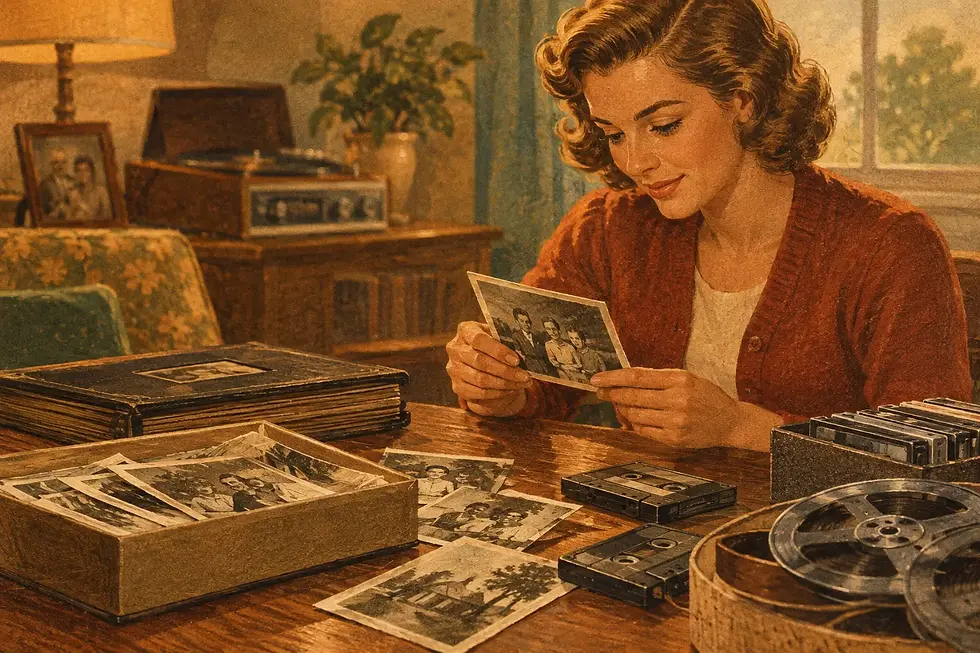
Photos help, but they are not required to begin. Many families make the mistake of waiting until every picture is scanned and every date is confirmed. Start with the stories. Images and details can be added later. If a family has photos, handwritten notes, recipe cards, letters, or military records, those can deepen the book. If not, the spoken memories still carry enormous value.
Audio can matter too. Reading words on a page is powerful. Hearing a grandparent laugh halfway through a story is something else entirely. When audio is preserved alongside the text, the book becomes more than a document. It becomes a voice kept close.
DIY memory books versus guided help
There is no single right way to do this. Some families are happy using prompts, recording apps, or blank journals. If a grandparent enjoys writing and does not mind technology, that can work well enough.
Still, there are trade-offs. DIY tools tend to place the burden on the person whose stories matter most. They must answer prompts, organize thoughts, manage recordings, and often navigate software that was clearly designed by people who love dashboards. That can turn a meaningful project into homework.
Guided help removes that friction. Instead of asking grandparents to become writers, editors, and tech support, it lets them do the one thing they already know how to do - tell the truth about their lives. For families who want a dignified result without pushing an older parent through a maze of logins and upload buttons, personal support is usually worth it.
That is one reason services like Heritage Circle resonate with families who want something more human. A real person listens, asks thoughtful questions, shapes the material carefully, and creates a finished book that feels like the storyteller, not a template.
How to choose the right format
A printed hardcover has emotional weight. It can sit on a coffee table, be wrapped as a gift, and passed down in a very literal way. For some families, that physical presence is the whole point.
A digital version has its own strengths. It is easier to share, simpler to preserve, and useful for relatives scattered across different states. A color PDF or private online page can reach more family members quickly, and digital preservation adds peace of mind.
Often, the best answer is both. A digital version keeps the stories accessible, while a printed version gives them permanence in the home. It depends on budget, family size, and how the book will be used. There is no need to force an either-or choice if both serve the family in different ways.
Questions worth asking a grandparent
The strongest questions are not always the biggest ones. "Tell me about your childhood" can feel too wide. "What did your house smell like when you were growing up?" tends to open a door.
Good prompts invite story, not short answers. Ask about favorite jobs, hardest lessons, first memories of a spouse, family sayings, holiday routines, moments of fear, moments of pride, and things they hope the family never forgets. If someone says, "Oh, that is not interesting," that is often your sign to keep going. Those are frequently the stories everyone loves.
A gentle interviewer also knows when not to push. Some memories are tender. Some are private. A good memory book honors the person telling the story, not just the curiosity of the people listening.
What families receive in the end
At its best, this is not just a project. It is relief. Relief that the stories were captured. Relief that someone finally took the time to ask. Relief that future grandchildren will know more than names and dates.
A well-made book of memories for grandparents becomes a family anchor. It gives younger generations something steady to return to when they want to understand where they came from. It also gives grandparents a rare gift: the chance to feel heard while they are still here to enjoy it.
You do not need a perfect storyteller, a box of organized photos, or a relative with endless free weekends. You just need a beginning, a listening ear, and a way to preserve what matters before it slips further out of reach. The stories are already there. Sometimes all that is missing is someone kind enough to help gather them.