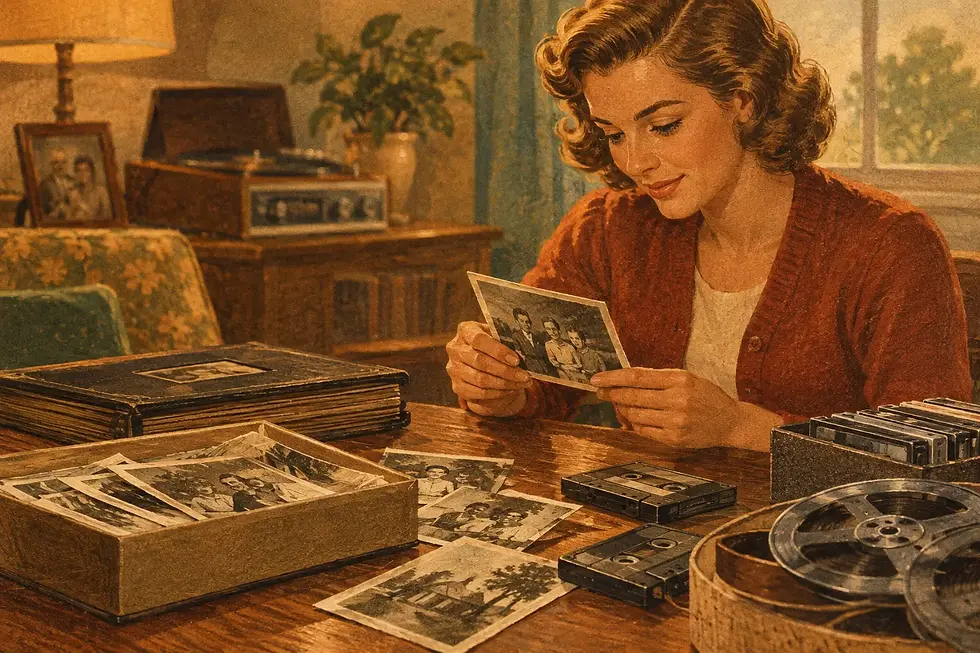
A Gift for Parents to Share Stories That Last

The best gift for parents to share stories is not another object that needs a shelf, a charger, or careful storage. It is a chance to be heard. For many parents and grandparents, the stories that matter most have never been written down: the summer jobs, the first apartment, the recipe learned at someone’s elbow, the hard season they survived, and the small decisions that shaped a family.
A personal-history gift gives those memories a home. Done well, it does more than collect facts. It preserves a person’s voice, sense of humor, values, and way of seeing the world. Years from now, children and grandchildren may not remember every detail, but they will be grateful to know how their family sounded when they told the story themselves.
Why stories are a meaningful gift for parents
Parents often reach a point when they are less interested in receiving more things and more interested in passing something on. That does not mean they want to sit alone at a computer and write a memoir. In fact, many people have wonderful stories but feel intimidated by a blank page, unfamiliar technology, or the idea that their life is somehow not “important enough” for a book.
That is where a guided storytelling gift changes the experience. Instead of asking a parent to perform as a writer, it invites them into a conversation. A good interviewer knows how to slow down, listen for the detail behind the detail, and ask the gentle follow-up question: “What was that like?” Often, that is all it takes for a memory to open.
The result is also different from a standard photo album. Photos show what a family looked like. Stories explain who they were. A photograph of a modest house becomes more meaningful when a parent recalls saving for the down payment, painting the nursery at midnight, or welcoming every neighbor who stopped by with a casserole.
What makes a story-sharing gift easy to accept
The most thoughtful gift is one your parent will actually use. That sounds obvious, but it rules out many well-meaning options. A journal full of prompts can be lovely for someone who enjoys writing. A recording app may suit a person who is comfortable with technology. Neither is ideal for everyone.
For a parent who says, “I wouldn’t know where to begin,” personal support matters more than features. Look for a process that begins with a real conversation, not a login screen. The parent should not have to learn software, format a manuscript, edit audio, scan files, or wonder what happens after the interview is over.
It also helps to make clear that this is not a test of memory. They do not need to recall every date perfectly or tell their life in perfect order. Family stories are allowed to be imperfect, funny, tender, and occasionally contradictory. That is part of what makes them human.
A comfortable pace matters
Some parents will happily talk for hours. Others will prefer one shorter conversation at a time. A thoughtful service can work around energy, health, hearing, and attention. It should leave room for pauses and for the stories that surface unexpectedly.
A parent may begin by discussing childhood and suddenly remember the neighbor who taught them to drive, or the teacher who changed their confidence. Those side paths are not distractions. They are often the passages a family treasures most.
What a gift for parents to share stories can include
There is no single right format. The best choice depends on what your parent values and how your family hopes to use the finished work. A professionally shaped legacy book is especially meaningful for families who want something tangible to hold, give, and revisit. It can turn spoken memories into a clear, readable narrative without sanding away the speaker’s personality.
Audio is equally powerful. Reading a parent’s words is moving; hearing their laugh before a story, their familiar phrases, or the emotion in their voice can feel like sitting across the kitchen table again. When audio is paired with a printed or digital book through simple QR codes, family members can enjoy both the polished story and the voice behind it.
A private family web page can make sharing easier for relatives who live far apart. A digital edition offers practical protection, too. Paper books can be misplaced, damaged, or passed from one household to another. A carefully preserved digital copy gives the family another way to keep the work available.
For some families, the project may grow beyond one life story. Old photographs can be restored and identified. Family-tree details can be organized. Several siblings can add memories of the same parents. That expansion can be wonderful, but it is not required. A short collection of honest stories is enough to become an heirloom.
How to give the gift without making it awkward
The occasion can be a birthday, retirement, anniversary, holiday, or Mother’s Day and Father’s Day. But the presentation matters more than the calendar. Avoid framing it as a task your parent needs to complete for the family. That can make even a generous gift feel like homework.
Try something simpler: “I love the stories you tell, and I want to make sure we keep them. I found a way for someone to talk with you and turn those conversations into something we can all enjoy.” This tells them the gift is about appreciation, not pressure.
If your parent is hesitant, begin with a small scope. One interview about growing up, meeting their spouse, military service, early work, parenting, or a favorite family tradition can be plenty. Once they see that the conversation is relaxed and respectful, they may want to continue. If they do not, the stories gathered still matter.
It is wise to ask what feels private, too. A legacy project should be owned by the storyteller, not mined for family gossip. Parents can choose what to include, what to soften, and what to leave out. Respecting those boundaries builds trust and usually leads to more honest storytelling.
Questions that invite memories, not one-word answers
The strongest questions are specific enough to spark a scene but open enough to let your parent lead. Instead of asking, “What was your childhood like?” you might ask, “What did a Saturday morning look like when you were ten?” Rather than “Tell me about your job,” ask, “Who was the first person who took a chance on you?”
Questions about ordinary life often work beautifully. What did their family eat when company came over? What song takes them straight back to high school? Which relative made everyone laugh? What did they learn from their own parents that they tried to carry into raising children?
The point is not to create a complete historical record in one sitting. It is to preserve the moments only they can explain.
Why professional help makes a difference
Family members are often excellent listeners, but interviews can be emotionally complicated. A child may already know a story so well that they skip past it. A parent may avoid a difficult subject because they do not want to worry someone they love. A skilled, neutral interviewer can give the storyteller room to speak at their own pace.
Professional help also takes care of the work after the conversation: transcription, light editing for readability, formatting, audio handling, and producing a finished book. That work is easy to underestimate until a family tries to assemble recordings and notes on its own. The goal is not to make a parent sound like someone else. It is to shape their spoken words into a lasting form while keeping their voice recognizable.
Heritage Circle was built around this human-first approach. The founder personally conducts interviews and handles the production work, so families are not handed an app and a stack of instructions. The core service can include an interview, transcription, light editorial shaping, a color PDF book, audio access, a private shareable page, and long-term digital preservation, with printed hardcover copies available at cost for families who want them.
That level of care is especially valuable when a parent is not comfortable with computers, when family members live in different states, or when there is a sense that the stories should be captured sooner rather than later. Still, urgency does not have to mean rushing. The best projects make room for dignity, choice, and a good conversation.
A parent may never call their own life remarkable. But the people who love them know better. Give them a quiet place to tell the stories, and give those stories a form that can stay in the family long after the conversation ends.